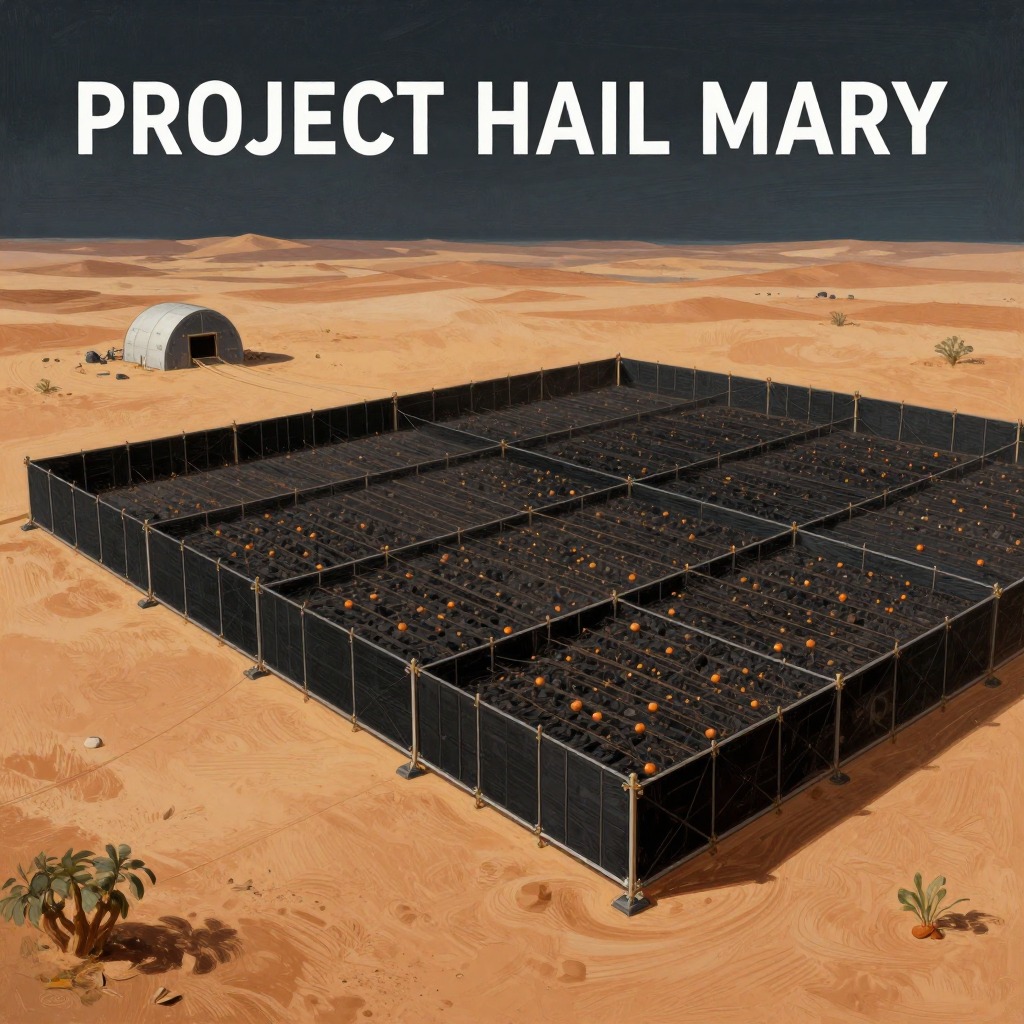
Blackpanels
Blackpanels are the industrial-scale Astrophage breeding system conceived by the imprisoned engineer Bob Redell and implemented under Eva Stratt's authority, representing humanity's most ambitious and controversial engineering project during the Astrophage crisis. By paving a substantial portion of the Sahara Desert with simple, mass-producible solar collectors, the Blackpanels transformed the planet's surface into a gigantic factory capable of generating the two million kilograms of enriched Astrophage required to propel the Hail Mary to Tau Ceti, while simultaneously reshaping global climate patterns and geopolitical power structures.
Design and Principle
Bob Redell, a New Zealand engineer serving a life sentence for culpable homicide and embezzlement, devised the Blackpanel concept while incarcerated at Auckland Prison. He described the design to Eva Stratt and Ryland Grace during a prison interview: a square of black-anodized metal foil, covered by clear glass with a one-centimeter gap, sealed at the edges with insulating materials like brick or foam. When placed in sunlight, the black foil absorbs solar energy and heats up, while the glass traps the heat, allowing the panel to reach an equilibrium temperature well above 100 degrees Celsius. At this temperature, Astrophage can be enriched—that is, they absorb heat energy and store it without being triggered to breed. Redell incorporated a static magnet to simulate the sun's magnetic field, an IR filter that only admits the carbon dioxide spectral signature wavelengths (4.26 and 18.31 microns) to trigger breeding, and a small pinhole for air exchange to replenish CO2 consumed during reproduction. The entire system was designed to be made from foil, glass, and ceramics—materials abundant on Earth—enabling unprecedented scalability.
Scale and Implementation
Redell calculated that a single one-square-meter Blackpanel, under ideal weather conditions with one thousand watts per square meter of solar energy, could produce about half a microgram of Astrophage per day. To reach the required production rate of a thousand kilograms per day, he estimated that two trillion square meters of panels would be needed—roughly a quarter of the Sahara Desert's nine trillion square meters. Stratt, wielding near-absolute authority granted by a unanimous secret vote of every UN member nation, committed to redirecting the industrial bases of China and other manufacturing nations to produce Blackpanels. She also planned to compel North African governments to allow the project, arguing that after the crisis, those governments would retain the panels and become the world's industrial-energy powerhouse, permanently lifting Africa out of poverty. Redell was immediately drafted into the project, transferred from prison to Stratt's aircraft-carrier laboratory.
Consequences and Significance
The Blackpanel project had profound and immediate environmental consequences. Dr. François Leclerc, the climatologist Stratt put in charge of mitigating the climate effects of Astrophage, reported that the massive disruption of heat distribution near the Mediterranean Sea caused by paving the Sahara was already contributing to bizarre weather phenomena worldwide: tornadoes in Europe, a shifted cyclone season, snow in Vietnam, and a chaotic jet stream. Leclerc estimated that without intervention, half the human population—3.5 billion people—would die within nineteen years from crop failures and famine. The Blackpanels, while essential for producing the Hail Mary's fuel, thus became a direct contributor to the accelerating climate catastrophe, forcing Stratt to authorize additional drastic measures such as the nuclear bombardment of Antarctica to release methane and buy time. The Blackpanels ultimately succeeded in their primary mission: they generated the two million kilograms of enriched Astrophage needed to fuel the Hail Mary, enabling humanity's last hope for a scientific solution to the Astrophage threat.